

Starting an automotive business has evolved significantly beyond securing a physical roadside yard and waiting for foot traffic. While physical commercial spaces remain familiar across major urban commercial hubs such as Dar es Salaam, Mwanza, and Arusha, modern car buyers conduct the majority of their preliminary research online before ever scheduling a physical viewing. Establishing a modern dealership today requires combining reliable vehicle sourcing and disciplined operational workflows with a digital showroom that presents inventory clearly to prospective buyers.
Operating an online showroom allows dealers to display inventory around the clock, connect with buyers across different cities, and manage incoming interest systematically. Whether a dealership focuses on popular city runabouts, commercial workhorses, or high-clearance four-wheel drives, a digital storefront removes geographic bottlenecks. A buyer in Arusha or Mwanza can evaluate stock based in Dar es Salaam, review detailed specifications, and contact sales teams directly with well-defined intent.
This comprehensive guide outlines the step-by-step process of starting a car dealership and establishing a high-performing digital showroom. You will learn how to structure your commercial operations, curate inventory tailored to customer preferences, deploy dedicated team management and lead tracking systems, and utilize modern marketplace tools to scale your automotive business efficiently.
Key Takeaways
- Launching a successful automotive dealership requires balancing dependable inventory sourcing with an active, accessible digital storefront.
- Establishing an online showroom extends dealer reach far beyond local drive-by foot traffic to active vehicle shoppers across Dar es Salaam, Mwanza, and Arusha.
- Presenting transparent vehicle specifications and clear photography helps buyers quickly find a car by preferences that match their everyday driving needs.
- Integrated digital dealership tools—including team collaboration, lead tracking, and order handling—streamline daily sales operations and prevent lost inquiries.
- Registering through ShowroomPal's Become-Seller program provides automotive dealers with an intuitive management system and direct access to engaged car shoppers.
Foundations of Starting a Car Dealership: Sourcing, Setup, and Strategy
Establishing an automotive dealership requires clear operational foundations long before vehicle listings go live. A successful dealership operates with a defined sourcing strategy, an understanding of working capital requirements, and an awareness of regional customer demands. Automotive retail is a capital-intensive business; therefore, every vehicle acquired must align with verifiable market liquidity.
Most dealerships build their initial stock through established international auction channels, direct regional imports, or curated local trade-ins. Direct imports entering through the port in Dar es Salaam often supply dealerships nationwide, where vehicles are cleared, detailed, and prepared for retail. Local vehicle acquisition through direct purchase, consignment, or part-exchange arrangements provides another continuous inventory pipeline with shorter turnover cycles.
Understanding Regional Market Demand
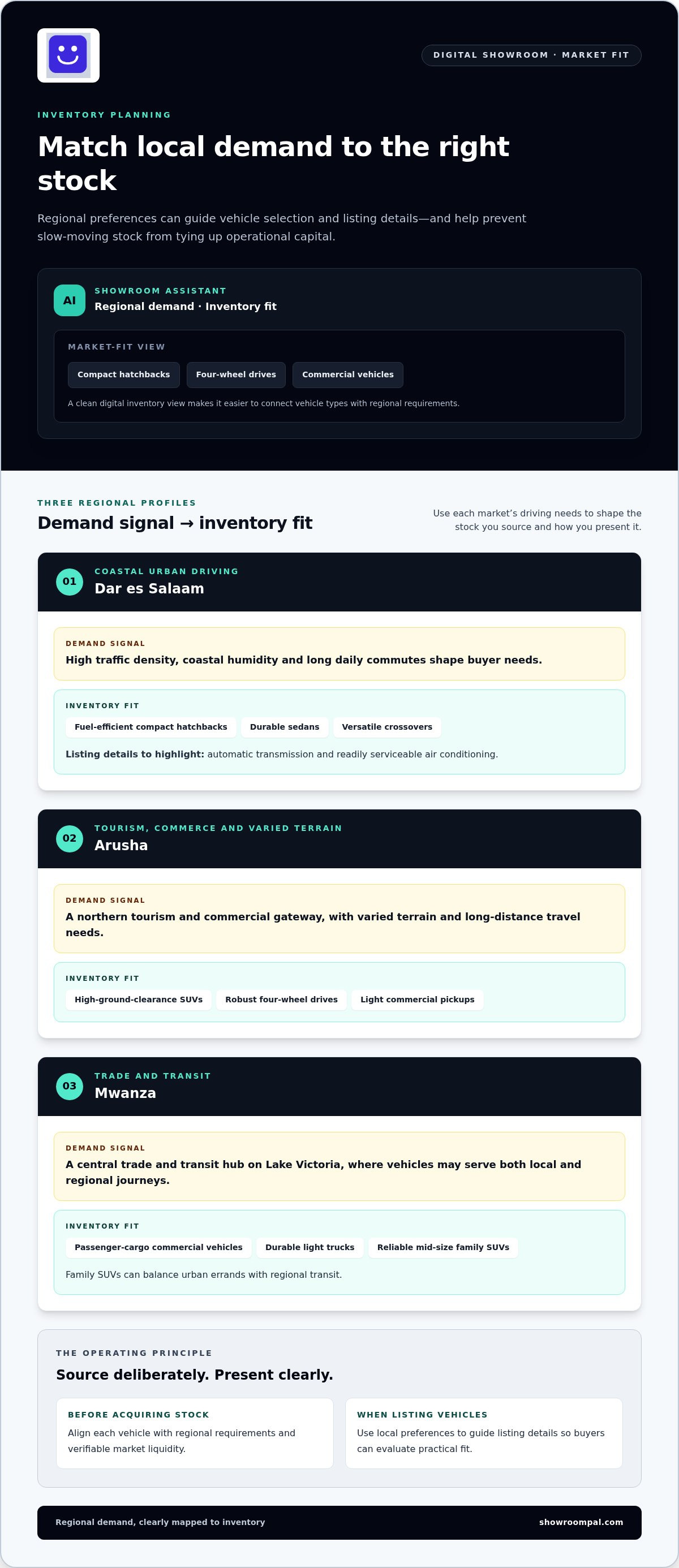
Vehicle demand varies noticeably across major commercial hubs. Aligning inventory with specific regional requirements prevents slow-moving stock from tying up operational capital:
- Dar es Salaam: High traffic density, coastal humidity, and long daily commutes drive sustained demand for fuel-efficient compact hatchbacks, durable sedans, and versatile crossovers. Automatic transmissions and readily serviceable air conditioning systems are baseline market requirements for daily commuters.
- Arusha: Serving as a major northern tourism and commercial gateway, Arusha demands rugged, high-ground-clearance sport utility vehicles (SUVs), robust four-wheel drives, and versatile light commercial pickups capable of managing varied terrain and long-distance travel.
- Mwanza: As a central trade and transit hub on Lake Victoria, Mwanza sees strong demand for dual-purpose passenger-cargo commercial vehicles, durable light trucks, and reliable mid-size family SUVs that balance urban errands with regional transit.
Use these regional preferences to guide inventory selection and listing details for buyers in each market.
Structuring Your Business Operations
Equally critical is establishing dependable third-party service partnerships. Secure reliable mechanical specialists, auto detailers, and secure storage yards. Even if your operational model leans heavily on digital sales, vehicles must be cleanly prepped, mechanically sound, and readily accessible for pre-purchase client inspections.
Building and Optimizing Your Online Showroom
An online showroom serves as your dealership’s primary sales floor. While a traditional lot is restricted by physical real estate, operating hours, and local foot traffic, a digital showroom remains accessible 24 hours a day to prospective vehicle buyers everywhere. However, an effective digital presence requires more than simply uploading random snapshots to informal messaging channels.
Professional digital merchandising demands structure, clarity, and comprehensive vehicle details. Automotive buyers evaluate listings critically; they look for clear indicators of condition, transparent pricing, and functional specifications that answer their practical needs before making contact.
Standardizing Vehicle Presentation
Use a consistent vehicle intake photography process so that every listing presents the same essential views:
- Consistent exterior framing: Photograph every vehicle from uniform angles—front three-quarters, direct side profile, rear three-quarters, and full front and rear. Ensure the vehicle is clean and parked in an uncluttered, evenly lit area.
- Detailed interior captures: Provide clear shots of the dashboard, instrument cluster with visible mileage, steering wheel, front and rear seating condition, headliner, and boot space.
- Mechanical and functional points: Include focused images of the engine bay, tyre tread condition, undercarriage clearance, and any unique accessories such as roof rails, bull bars, or alloy rims.
- Transparent disclosure: Clearly show minor cosmetic wear, scuffs, or dents in the listing photos and description.
Transparent digital presentation reduces redundant questions and ensures that buyers who reach out are already well-informed and genuinely interested in purchasing.
Helping Buyers Find a Car by Preferences
Online car shoppers do not merely search by broad brand categories; they approach marketplaces looking to search cars by budget and match practical, non-negotiable everyday criteria. A prospective buyer may require an automatic transmission, seating for seven passengers, elevated ground clearance, or a specific engine displacement to manage commuting costs.
To help shoppers find a car by preferences easily within your digital showroom, ensure every vehicle profile is fully populated with structured data fields:
- Make, model, and manufacturing year: Clearly specify exact model codes and trim levels rather than generic labels.
- Powertrain and transmission: Detail the engine capacity (e.g., 1,500cc vs. 2,000cc), fuel type (petrol or diesel), and drivetrain (2WD vs. full-time or selectable 4WD).
- Body configuration: Categorize accurately as hatchback, saloon, compact crossover, wagon, SUV, or pickup.
- Feature checklists: Highlight functional utility—push-to-start convenience, reverse camera, multi-zone air conditioning, cruise control, or folding rear seats.
Accurate attribute indexing allows marketplace search filters and intelligent search algorithms to match your listings with buyers searching for those precise specifications. To understand how modern search tools connect dealers with motivated buyers, explore how to use AI car listings for dealerships to maximize digital visibility.
Streamlining Dealership Operations: Team Collaboration, Leads, and Orders
As vehicle inventory expands, organized administrative management becomes essential. Dealerships need tools that centralize communication, coordinate sales personnel, and track transactions from initial interest to final vehicle handover.
Modern automotive platforms equip dealerships with purpose-built back-office tools designed specifically to streamline daily sales operations, manage internal sales teams, and track pipeline velocity.
Centralized Team Management
Most automotive dealerships rely on a collaborative sales structure comprising dealership principals, lot managers, field brokers, and dedicated sales representatives. Without clear organizational tools, internal sales representatives frequently duplicate outreach, provide inconsistent pricing information, or fail to follow up on aging inquiries.
A centralized dealership management system allows dealership administrators to assign role-based permissions, delegate specific vehicles to designated sales agents, and review response metrics. When team members collaborate within a single administrative workspace, managers maintain clear visibility into which representatives are handling incoming inquiries, how rapidly leads are being addressed, and which inventory items are generating the highest commercial engagement.
Systematic Lead Tracking
Every inbound inquiry represents a customer who has expressed active interest in your inventory. Treating every inquiry systematically is what separates growing commercial operations from stagnant ones. A structured lead management process transitions prospective buyers through distinct, traceable stages:
| Sales Stage | Operational Objective | Dealer Action Items | Key Tools Utilized |
|---|---|---|---|
| Inquiry Intake | Capture initial interest and buyer criteria | Record customer contact details, preferred budget, vehicle preference, and location | Automated lead capture, marketplace messaging |
| Qualification | Confirm purchase readiness and timing | Clarify payment method, trade-in interest, and preferred timeline for vehicle viewing | Lead assignment tools, internal CRM notes |
| Viewing & Test Drive | Facilitate physical inspection and evaluation | Schedule appointment at showroom or secure storage facility; prepare vehicle documentation | Calendar scheduling, sales representative tracking |
| Negotiation & Agreement | Finalize pricing, terms, and paperwork | Issue pro-forma invoice, verify registration cards (kadi ya gari), and agree on handover date | Order handling dashboard, transaction logs |
| Handover & Follow-up | Complete vehicle delivery and foster referrals | Execute vehicle transfer, provide maintenance records, and establish post-sale contact | Customer profile archives, team performance tracking |
Tracking leads through an integrated system ensures that prospective buyers who do not buy immediately are retained in your customer database. When relevant new stock arrives matching their specified preferences, your sales team can re-engage them with a tailored recommendation.
Structured Order Handling and Deal Closures
Closing an automotive sale involves precise administrative coordination. Beyond agreeing on purchase price, dealerships must manage formal invoicing, payment receipts, statutory vehicle registration transfer documentation, and physical delivery releases.
Utilizing dedicated order handling modules within your digital showroom keeps vehicle sales documented with clear transaction records. Dealership managers can track inventory units that are reserved, pending processing, sold, or archived from public listings.
Connecting With Buyers in Dar es Salaam, Mwanza, and Arusha
Expanding your dealership’s market footprint requires looking beyond your immediate municipal boundaries. The automotive marketplace is fundamentally interconnected; regional buyers frequently look to major transit hubs to find vehicles that are scarce in their local market. Simultaneously, urban buyers often seek out well-maintained commercial vehicles stationed in regional trading centers.
Operating a digital showroom bridges this geographical gap, allowing a dealership physically situated in one city to market transparently to buyers residing hundreds of kilometers away.
Optimizing for Urban and Intercity Commuters in Dar es Salaam
Dar es Salaam represents the largest automotive market in the region, driven by continuous corporate activity, port logistics, and rapid suburban expansion. Dealerships serving this demographic must optimize their inventory descriptions around urban drivability, fuel economy in stop-and-go congestion, and ease of routine servicing.
When listing vehicles targeting urban commuters, emphasize practical daily attributes. Note specific fuel economy metrics, highlight compact vehicle footprints that simplify parking in congested business districts, and detail cooling performance. Demonstrating that a vehicle is primed for reliable daily city operation resonates directly with professionals seeking dependable everyday transport.
Serving Commercial and Tourism Needs in Arusha
In Arusha, vehicle buyers prioritize mechanical resilience, off-road capability, and passenger comfort over compact city dimensions. The regional economy is anchored by international tourism, agriculture, and cross-border trade, requiring vehicles capable of navigating rough murram roads, national park tracks, and long highway journeys.
When positioning inventory for northern buyers, include practical details such as ground clearance, 4WD engagement modes, suspension features, and luggage capacity.
Meeting Agricultural and Trade Requirements in Mwanza
The Lake Zone economy centered in Mwanza requires multi-functional vehicles that balance family utility with durable cargo capacity. Trade in agricultural produce, commercial fishing logistics, and mining supply operations create strong demand for double-cabin pickups, rugged utility vans, and durable medium-displacement SUVs.
In your digital listings, highlight payload capacity, towing capability, cabin durability, and parts availability so buyers can compare vehicles against their trade and transport requirements.
Scale Your Dealership With ShowroomPal’s Become-Seller Program
ShowroomPal gives dealers a ready-to-use way to establish an online showroom, organize vehicle listings, and manage digital sales activity without building a proprietary e-commerce website from scratch.
ShowroomPal’s Become-Seller program is engineered specifically to provide independent automotive dealers, brokers, and established commercial dealerships with the digital infrastructure required to sell vehicles online efficiently.
Core Capabilities of the ShowroomPal Dealer Ecosystem
Onboarding your dealership through ShowroomPal unlocks an array of operational and promotional tools designed to streamline digital vehicle merchandising:
- Dedicated Digital Showroom: Showcase your complete inventory within a branded, professional seller profile that displays your contact details, physical business location, and available stock in one organized portal.
- Intuitive Inventory Management: Upload, edit, categorize, and archive vehicle listings seamlessly. Update pricing, upload high-resolution image galleries, and add comprehensive technical specifications in minutes.
- Integrated Team Collaboration: Manage internal dealership staff, delegate listing responsibilities, and coordinate sales agents within a shared administrative dashboard.
- Active Lead Tracking: Monitor buyer interactions, track customer inquiries, and ensure prompt response times across your entire sales organization.
- Streamlined Order Handling: Track pending sales, manage vehicle reservations, and maintain clear records of finalized transactions.
Intelligent Vehicle Discovery via Pal AI Assistant
A distinctive competitive advantage of ShowroomPal is the integrated Pal AI Assistant. Rather than forcing shoppers to navigate endless pages of unfiltered listings, the conversational AI assistant interacts directly with prospective car buyers to understand their personal needs, lifestyle requirements, and commercial constraints.
When an interested shopper tells the AI assistant that they need an automatic five-door hatchback with low fuel consumption for daily city driving, or a robust four-wheel drive suited for northern road conditions, the system evaluates active platform inventory and presents closely matched dealer listings.
ShowroomPal operates purely as a discovery and advertising marketplace connecting verified dealerships directly with active buyers. The platform does not handle vehicle financing, cross-border shipping, mechanical repairs, or subjective condition guarantees—empowering your dealership to manage customer relationships, negotiate sale prices, and conclude transactions directly on your own commercial terms.
Register Your Business and Start Selling on ShowroomPal
Moving from a physical lot to an online showroom helps dealers present inventory to buyers in Dar es Salaam, Mwanza, Arusha, and other regional markets.
An organized online showroom helps your team present inventory clearly, collaborate on sales activity, track buyer interest, and manage orders in one place.
Take your automotive dealership to the next level today. Register your business through ShowroomPal's Become-Seller program, configure your digital showroom, and connect directly with motivated car shoppers ready to buy.
Register your dealership on ShowroomPal and start selling today.
Frequently Asked Questions
How do I start a car dealership business?
Starting an automotive dealership requires choosing a clear sourcing channel, such as direct imports, local trade-ins, or vehicle consignment, and establishing a professional presence. Pairing a secure vehicle storage or viewing lot with an online showroom gives buyers a convenient way to discover your inventory and contact your team.
What are the advantages of an online showroom over a traditional yard?
A physical car yard is limited by geographic location, physical storage capacity, and standard operating hours. An online showroom remains accessible to vehicle shoppers across different cities, allowing dealers to display inventory, share specifications, and receive buyer inquiries online.
How does ShowroomPal support dealership team collaboration?
ShowroomPal provides dealerships with integrated business management tools that allow dealership principals to add team members, delegate listing responsibilities, and collaborate within a centralized workspace. Sales managers can assign incoming leads to specific sales representatives, monitor inquiry statuses, and track inventory velocity, preventing administrative confusion and missed customer inquiries.
What vehicle attributes should I include in my online listings?
To help shoppers find a car by preferences, provide thorough, accurate specifications on every listing. Include the precise make, model, manufacturing year, engine displacement, fuel type (petrol or diesel), transmission type (automatic or manual), drivetrain configuration (2WD, 4WD, or AWD), seating capacity, verified mileage, and key convenience features. High-resolution photos showing exterior profiles, interior wear, dashboard gauges, and undercarriage condition build immediate buyer confidence.
How do lead tracking and order handling work on the platform?
The platform’s back-office tools centralize buyer inquiries in one dashboard. Dealership teams can view lead history, record customer requirements, update inquiry progress, and manage vehicles as reserved or sold through organized order handling.
Can dealerships outside Dar es Salaam sell effectively on ShowroomPal?
Yes. ShowroomPal serves automotive dealerships and car buyers throughout the country, including major regional markets such as Mwanza and Arusha. Operating an online showroom enables regional dealerships to advertise their specialized local inventory—such as commercial pickups, safari-grade 4x4s, and utility vehicles—to buyers searching for those exact models across the broader automotive market.

Disclaimer
This article is for general informational purposes only. Please verify important details before making decisions. ShowroomPal is not responsible for losses arising from reliance on this content, to the extent permitted by law.

